
Customer Segmentation & Targeted Marketing Strategy
Objective
This project aims to segment a gym chain's 2,000-member customer base to drive targeted marketing and service offerings. By applying K-Means++ and Agglomerative clustering techniques to demographic and socioeconomic data, the objective is to identify distinct customer personas and translate these data-driven insights into actionable acquisition, retention, and upselling strategies.
tool
Python, Pandas, Scikit-Learn, Matplotlib, Seaborn, K-mean, agglomerative clustering
firm analysed
dibs
Role
Data Analyst & Marketing Executive

Project Overview
Customer segmentation enables targeted service offerings and marketing for the gym chain. This analysis aims to identify distinct member groups using demographic and socioeconomic attributes. After an initial data description, exploratory analysis will characterise distributions. Next, the optimal number of clusters is determined via the Elbow Method and Silhouette analysis. Finally, both K means++ and Ward Agglomerative clustering are applied (with age and income standardised), yielding interpretable segment profiles and tailored recommendations.
Exploratory Data Analysis
1. Data Descriptions
The dataset contained seven key attributes: Gender, Marital Status, Age, Education, Income, Occupation, and Settlement Size.
Initial data profiling revealed that the average member age is approximately 41 years, with a mean income of ~$137,500. However, the income data exhibited a strong right-skew.

Continuous Variables Analysis
Table 2 reports summary statistics for age and income. Age ranges from 20 to 76 years (mean 40.82, SD 9.46), while income spans $35 832 to $309 364 (mean $137 516, SD $46 184), requiring standardisation to balance clustering influence.
Below bar-chart presents side-by-side histograms: age exhibits a near-normal distribution with a slight right tail, whereas income is markedly right-skewed.


Categorical Variable Analysis
To establish a baseline understanding of the membership base before applying clustering algorithms, I analyzed the distribution of our five key categorical and ordinal variables. The visual data revealed several distinct structural characteristics within our customer pool:
Gender Distribution
The dataset skews noticeably female, comprising 60.4% (1,209 members) compared to 39.6% male (791 members).
This 3:2 female-to-male ratio suggests that baseline facility usage and service demand likely lean toward female-preferred fitness modalities (e.g., group classes, specific equipment availability). From a marketing perspective, acquisition campaigns should ensure visual representation aligns with this majority while exploring targeted retention offers for the male minority.

Marital Status
The customer base is split perfectly down the middle: 50.0% Single (999) and 50.1% Non-single (1,001).
This even split highlights a highly bifurcated audience regarding lifestyle and potential purchasing behavior. It serves as an early indicator that a "one-size-fits-all" membership structure will be inefficient, immediately validating the need for distinct segment-specific pricing (e.g., individual vs. family plans).

Occupation & Employment
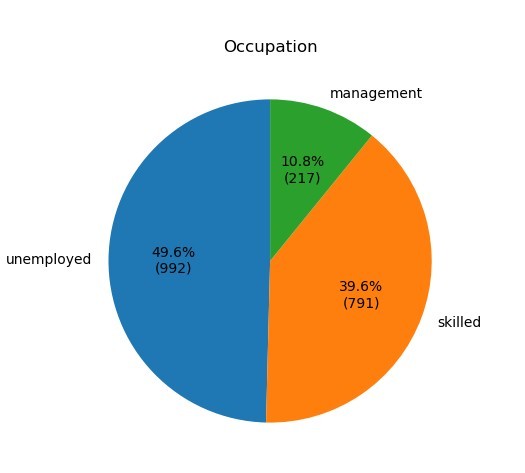
Nearly half of the base is categorized as unemployed/unskilled (49.6%, 992), followed closely by skilled workers (39.6%, 791), with a smaller fraction in management/professional roles (10.8%, 217).
The heavy concentration in the lower-to-middle tiers of the employment spectrum suggests a high sensitivity to price elasticity. Premium pricing models will likely only resonate with a fraction of the total base, whereas value-driven or heavily discounted introductory offers are necessary to capture and retain the largest segment.
Education Attainment
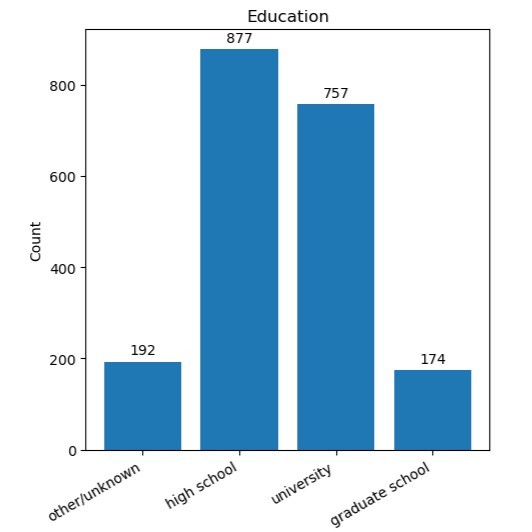
The highest concentrations lie in High School (877) and University (757) demographics, with much smaller subsets reporting Other/Unknown (192) or Graduate School (174).
Education heavily correlates with earning potential and career stage. The bimodal dominance of high school and university demographics mirrors the occupational split, reinforcing the presence of two distinct socio-economic realities within the gym's ecosystem.
Geographic Density
Geographic distribution is heavily polarized. Small cities make up the clear majority (1,130), followed by big cities (798). The mid-sized city demographic is almost non-existent (72).
This "missing middle" in geography means marketing channels and community engagement strategies must be distinctly localized. Small-city marketing can leverage tight-knit community networks and referral programs, whereas big-city strategies must focus on digital convenience, premium facilities, and competing in a saturated urban market.
Customer Segmentation
Variable Standardisation
Age and income were standardized because they are continuous variables with different scales – age spans decades while income ranges hundreds of thousands. Without z-scoring, income’s large numeric variance would dominate Euclidean distance and distort clustering.
Optimal Cluster Number
Below chart (left) shows the Elbow Method within-cluster SSE declines sharply to k = 2, then levels off suggest that k=2 might be the optimised number of clusters. The line graph on the right plots average silhouette scores peaking at k = 2 (0.545) and declining for higher k values.
Elbow Curve & Average Silhouette Score vs. k

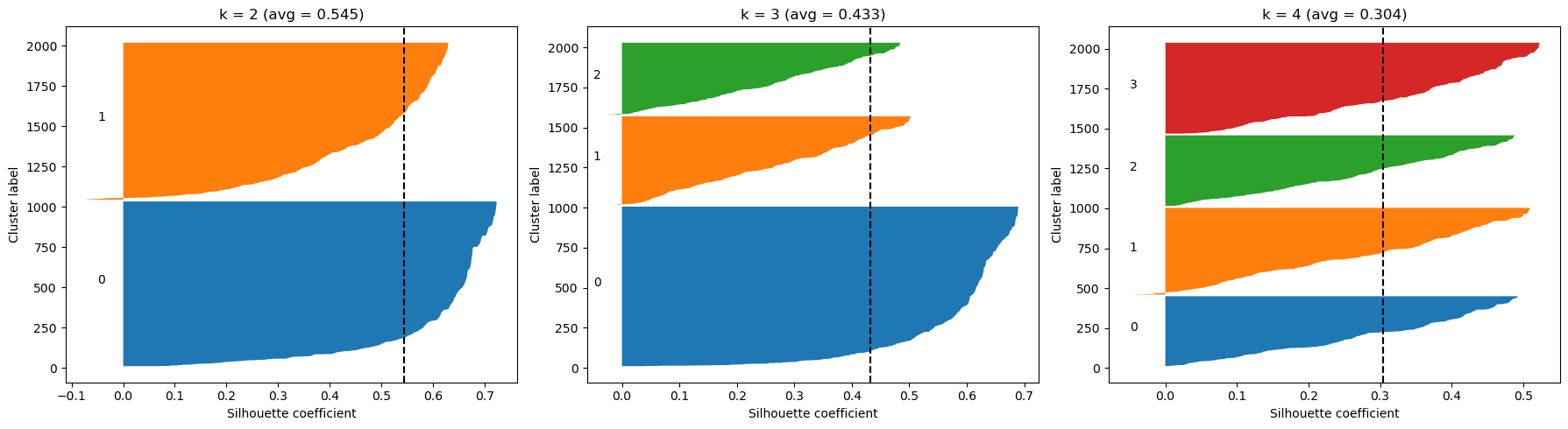
Detailed silhouette plots for k = 2, 3, and 4 (chart below) confirm that k=2 achieves the highest silhouette score (avg = 0.545) as k=2 yields the highest average silhouette (0.545), showing positive coefficients and minimal negative values, indicating optimal cluster cohesion and separation.
Silhouette Plots for k = 2, 3, 4
Model Execution & Cross-Validation
To guarantee that the segments were meaningful representations of the consumer base rather than algorithmic artifacts, two distinct unsupervised paradigms were deployed:
K-Means++ Clustering
K-means++ assigned 2 000 members into two segments. Table below presents the cluster centres and cluster sizes

Ward Agglomerative Clustering
Ward linkage produced very similar clusters. Table below summarises centres and counts

Final Segment & Comparison
Cluster 0 - “Young Single Starters”
• Profile: Mean age ≈ 33.8 years, only 3 % married, 37 % female, average income $103 257, education mean 0.84 (majority high-school or below), occupation mean 0.04 (predominantly unskilled), settlement mean 0.07 (small cities).
• Interpretation: This segment comprises early-career adults, largely single and male, with lower incomes and limited formal education, living mainly in small towns.
Cluster 1 - “Young Single Starters”
• Profile: Mean age ≈ 33.8 years, 0 % married, 35 % female, average income $103 341, education mean 0.81, occupation mean 0.00, settlement mean 0.06, count = 992.
• Interpretation: Matches the K-means++ “Young Single Starters”: younger, single adults with lower education and income levels, predominantly male and rural.
Cluster 1 - “Affluent Established”
• Profile: Mean age ≈ 48.2 years, 99 % married, 86 % female, average income $173 461, education mean 2.10 (university+), occupation mean 1.21 (skilled/professional), settlement mean 1.64 (mid-to-large cities).
• Interpretation: This segment represents mature, high-earning couples- mostly female-holding tertiary qualifications and professional roles, residing in urban areas.
Cluster 0 - “Affluent Established”
• Profile: Mean age ≈ 47.7 years, 99 % married, 86 % female, average income $171 149, education mean 2.10, occupation mean 1.21, settlement mean 1.59, count = 1008.
• Interpretation: Nearly identical to the K-means++ “Affluent Established” group, confirming a stable cluster of established, urban professionals with high disposable incomes.
Personalised Marketing Campaigns
Customer Persona

Urban, Affluent Professional Women (45+)

Younger, Budget-Conscious Single Men in Small Towns
Gender
Female (~86%)
Predominantly Male (~63% - 65%)
Marital status
99% in relationships
97% – 100% single
Age
~34 years (Mean: 33.8)
Educational level
Mostly university or higher
Mostly high school or lower
Average income
High income (~$171K – $173K)
Lower income (~$103K)
Occupation
Skilled, professional, managerial
Mostly unemployed or unskilled
Where they live
Large cities
Small towns
A premium audience suited for wellness packages, expert-led programs, and personalised membership upsells.
Ideal for low-cost flexible memberships, gamified challenges, and short-term motivational programs.
Recommended Marketing Campaign
SEGMENT 0
Mature, affluent, married women in big cities
What they value: wellness, quality service, expert-led programs, relationship-based engagement, and time efficiency.

“Wellness Platinum” lifestyle membership
Ideal for high-income and education-focused buyers interested in premium, all-in-one wellness solutions.
The Wellness Suite
• Offer full gym access bundled with value-added services like yoga, Pilates, reformer classes, nutrition consults, and spa access.
• Branding should emphasise balance, health, and sophistication to appeal to older professional women.
Delivery approach
• Email campaigns promoting long-term wellness and lifestyle benefits.
• In-app tools like “Build Your Wellness Plan” for personalised experiences.
• LinkedIn and Google Ads targeting urban professional women.
Couples and referral membership packages
Taps into both relationship status and social influence patterns typical of this demographic.
• With most of the segment being in a relationship, promote partner passes or dual memberships to drive long-term retention.
• Social wellness events such as couples yoga, wine nights, and bring-a-friend brunches create community engagement and word-of-mouth growth.
Delivery approach
• Personalised email invites to member-only events.
• QR-coded guest passes and referral cards in-club.
• Instagram ads featuring testimonials and event highlights.
Referral cards
Expert-led health and performance program
Appeals to smart, expert-led, health-focused fitness that aligns with their lifestyle and life stage.
• Develop evidence-based programs on longevity, posture, mobility, and stress relief led by physiotherapists, sports nutritionists, or certified trainers.
• Position them as structured, results-driven offerings with workshops, midlife strength plans, and educational seminars.
Delivery approach
• Weekly newsletters with expert tips and session updates.
• Premium member app access for booking, tracking, and video content.
• Facebook and LinkedIn content by affiliated wellness experts.
Health tracking
SEGMENT 1
Younger, lower-income, single men in small cities
What they value: affordability, flexibility, self-confidence, simplicity, motivation, and short-term wins.
“Essential Fit” flexible, low-cost membership
Ideal for individuals with lower incomes and unstable employment.
$
• Offer a flexible, affordable gym membership with basic access for under $15/week, no joining fee, and no lock-in contract.
• Optional upgrades such as weekend access or group classes allow customisation without complexity.
Delivery approach
• SMS offers such as “$10 first month — ends Sunday”.
• Targeted ads on Facebook and Instagram for single males aged 20–40 in regional areas.
• Posters in job agencies, community centres, and local stores.
App-based challenges and gamified rewards
Taps into the drive for recognition, motivation, and short-term wins.
• Introduce weekly fitness challenges such as “Train 3 Days = Win Gear” with in-app tracking and leaderboards to boost consistency.
• Simple rewards like drink vouchers, branded gear, or one-week upgrades encourage engagement at low cost.
Delivery approach
• App notifications with challenge invites and badges.
• In-club leaderboards to showcase progress.
• Automated SMS or email to reward streaks.
08:45
“Fit for Work” confidence program
Connects fitness with practical life goals: confidence, discipline, and employment.
• A six-week program designed to boost energy, posture, and appearance, marketed as a confidence-builder for job seekers and trade workers.
• Content should be simple, visual, and outcomes-focused, such as “Feel Stronger. Look Sharper.”
Delivery approach
• Flyers and sign-up forms at job centres, TAFEs, and local expos.
• Partnerships with regional employers and training providers for co-promotion and subsidies.
• Email series with weekly tips and progress tracking.
FEEL STRONGER
UP TO 50% OFF